Design solar systems quickly and precisely
Create professional PV designs in just a few minutes – from roof measurement to the finished wiring diagram. All in one platform.

From design to proposal in minutes
The entire workflow – from roof measurement to the ready-to-sign proposal.
Roof Design
Draw roof surfaces using 3D models, satellite images, or orthophotos. Mark obstacles and restricted zones intuitively.
Module Layout
Place modules automatically or manually on defined roof surfaces. Adjust spacing, tilt angles, and row arrangements and optimise the layout for maximum yield.
Optimisers
Design systems with module-level optimisers for maximum yield – especially with shading or different module orientations. Reonic calculates the additional yield compared to conventional string inverters.
Shading
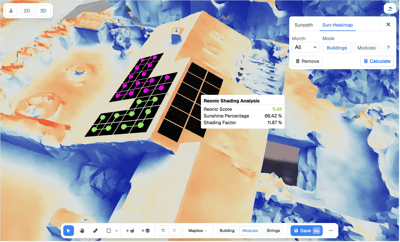
Simulate the sun path over the entire year and analyse the impact of obstacles on yield. Receive a heatmap showing yield losses for every point of the roof.
Map Data
Design on the data basis that best suits your project.
Wiring Diagram
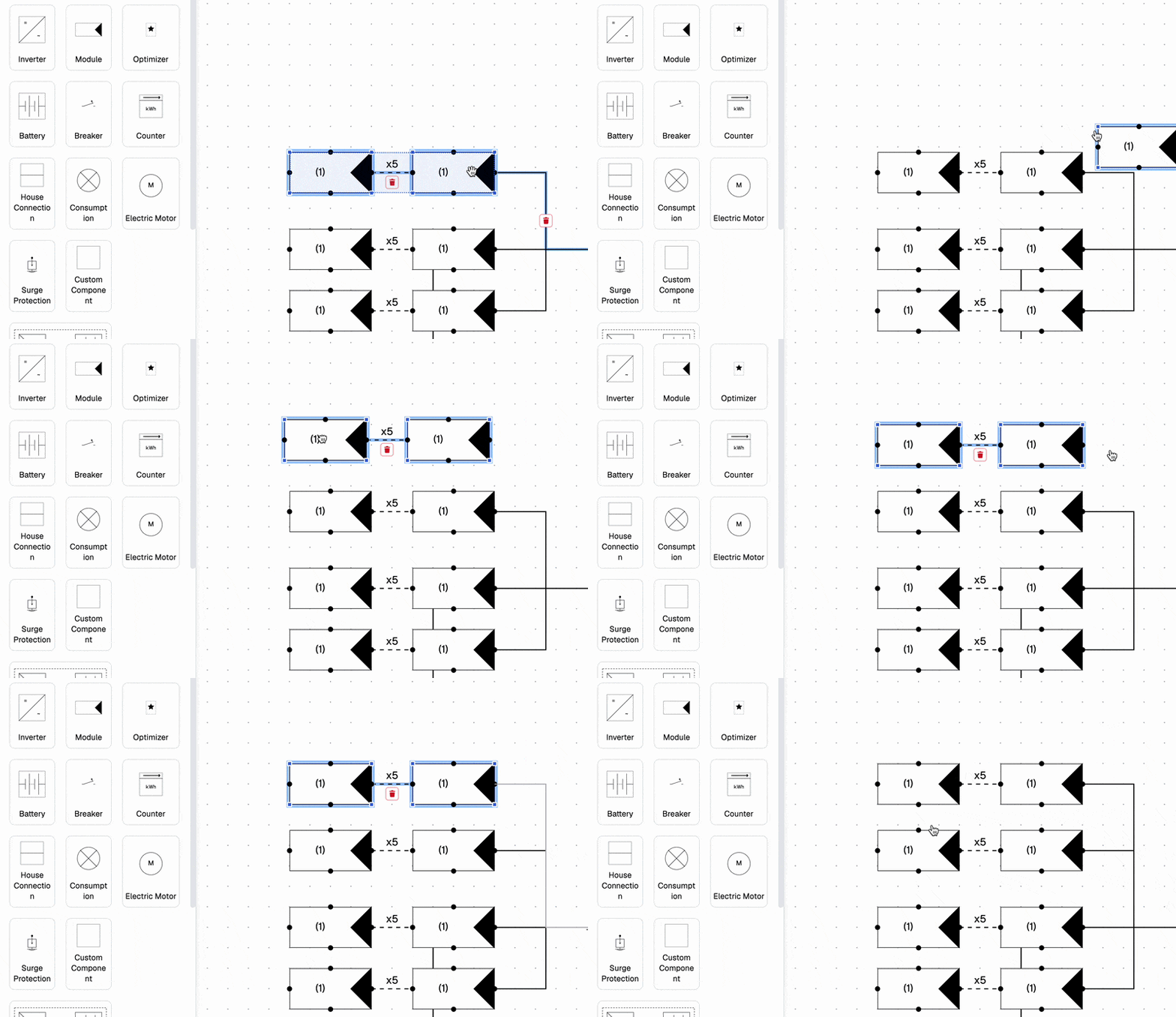
Reonic automatically generates electrical wiring diagrams for PV systems, battery storage, and heat pumps. Configure additional components directly in the diagram and export standards-compliant documentation.
Capture roofs quickly and precisely
Draw roof surfaces using 3D models, satellite images, or orthophotos. Mark obstacles and restricted zones intuitively.
Automatic measurement – Roof pitch, area, and orientation are detected
Flexible image sources – Satellite, orthophoto, drone, or customer photos
Setback rules – Usable area is calculated automatically

Simulate shading precisely
Simulate the sun path over the entire year and analyse the impact of obstacles on yield. Receive a heatmap showing yield losses for every point of the roof.
Interactive obstacles – Place trees, chimneys, neighbouring buildings
Yield heatmap – Losses per module shown visually
3D-based – Even more accurate shading with photogrammetry models
From design to finished wiring diagram
Reonic automatically generates electrical wiring diagrams for PV systems, battery storage, and heat pumps. Configure additional components directly in the diagram and export standards-compliant documentation.
All components – PV, battery, heat pump, EV charger
Standards-compliant – Meets requirements for grid registration
PDF export – Professional documentation in one click
Book a demo. Get to know all products and features.
In a personal product presentation, we'll show you all products and features. Free of charge, no obligation and tailored to your business and needs.
Book a demo
Reonic supports satellite images (Google, Apple, Bing, Mapbox), high-resolution orthophotos from aerial surveys, 3D building data (Google Solar API, Google 3D), and custom photogrammetry models from drone footage. You can also use customer photos or your own images as a planning basis.
Reonic automatically places modules on the defined roof surfaces, taking into account restricted zones, setback rules, and obstacles. You can then manually fine-tune – e.g. adjust module spacing, tilt angle, or orientation.
Power optimisers (e.g. from SolarEdge or Tigo) maximise yield at module level – especially with partial shading or different roof orientations. Reonic simulates the individual shading situation of each module and automatically calculates the yield difference with and without optimisers in kWh and euros.
The shading simulation calculates the sun path for every day of the year and considers obstacles such as trees, chimneys, and neighbouring buildings. With 3D data or photogrammetry models, accuracy is significantly increased further. The result is a heatmap showing yield losses per module.
Yes. Reonic automatically generates standards-compliant wiring diagrams for PV systems, battery storage, and heat pumps directly from the design. Additional components can be configured in the diagram editor. Export is as a professional PDF.
A complete PV design – from roof measurement through module layout and shading simulation to the finished proposal with wiring diagram – is possible in under 15 minutes.
The Reonic component database contains over 150,000 entries from more than 2,000 manufacturers – including modules, inverters, optimisers, batteries, EV chargers, and heat pumps.