There is no standalone solar panel grant in the UK in 2026: the main support is the Warm Homes: Local Grant in England, open to households on £36,000 a year or less (GOV.UK, 2026), plus 0% VAT on installation until 31 March 2027 and export payments under the Smart Export Guarantee. For installers, the job is less about chasing a single grant and more about knowing which route a customer can actually use.
This guide covers what is still available, who qualifies, what happened to ECO4, and how to screen enquiries so you do not promise funding that does not exist. Every scheme detail below was checked against GOV.UK, Ofgem or a named trade source in October 2026.
Key Takeaways
- No universal grant: solar panels are funded through the Warm Homes: Local Grant (England only), not through a national solar-only scheme.
- Warm Homes: Local Grant: usually for households on £36,000 a year or less, with an EPC rating of D to G and a privately owned home (GOV.UK, 2026).
- VAT: the 0% rate on solar installation runs until 31 March 2027, then 5% from 1 April 2027 (GOV.UK, 2026).
- ECO4: Ofgem lists it as running to 31 December 2026, but suppliers such as EDF are no longer taking new applications.
- SEG: suppliers must pay a rate above zero for exported power, and 2026 offers range from 12p to 25p per kWh.
What solar panel grants are available in the UK in 2026?
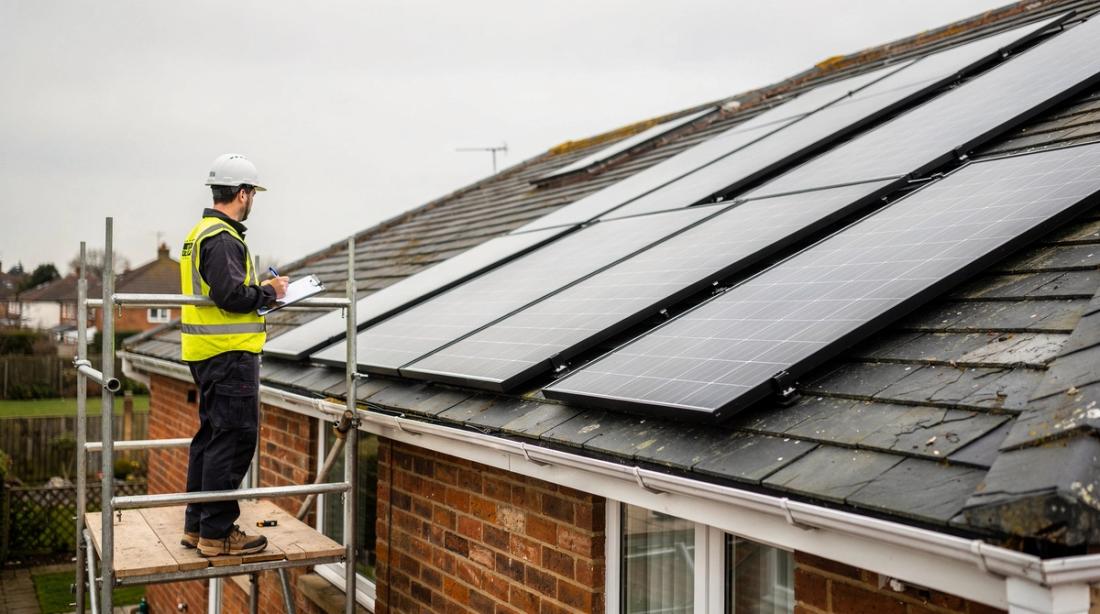
The only government-backed route that names solar panels as an eligible measure is the Warm Homes: Local Grant in England, which councils deliver for lower-income households. Everyone else relies on 0% VAT and the Smart Export Guarantee, which are tax relief and export payments rather than grants (GOV.UK, 2026).
The wider Warm Homes Plan was published on GOV.UK on 21 January 2026 and sets the policy direction for home upgrades in England. Scotland, Wales and Northern Ireland run separate schemes, so an enquiry from outside England needs a different answer. Our guide to the solar battery grant position covers the storage side in more detail.
Who qualifies for the Warm Homes: Local Grant?
The Warm Homes: Local Grant is aimed at privately owned homes in England with an EPC rating of D, E, F or G, where household income is usually £36,000 a year or less. Higher earners can still qualify if they live in a certain postcode area or someone in the household receives certain benefits (GOV.UK, 2026).
The home can be owned by the occupant or by a landlord. The council, not the installer, organises and pays for the agreed work, and GOV.UK says the council will usually make contact within 10 working days to arrange a home survey. The measures listed include insulation, air source heat pumps, smart controls and solar panels. Batteries are not listed on the GOV.UK page, so do not tell a customer that a battery is covered.
For a customer outside the grant criteria, the practical offer is a standard quote: panels installed at 0% VAT, paired with a Smart Export Guarantee tariff. That is still a strong proposition when installation costs are falling, as the DESNZ cost figures later in this guide show, and it avoids the delay of waiting for a council decision. Being clear about this early saves both sides time, because a customer who expects a grant and then learns they do not qualify can lose trust in the whole quote.
In practice this means the customer applies through the government route and the council decides what work to fund. An installer can help by checking the EPC and household details early, but the approved measures list is set by the council survey, not by the installer.
What happened to ECO4?
Suppliers such as EDF have stopped taking new ECO4 applications even though Ofgem still shows an end date of 31 December 2026. Ofgem says the scheme will run until 31 December 2026 after a nine-month extension, while EDF states it is not accepting new applications and that its current phase finishes at the end of March 2026.
EDF still lists adding solar panels among typical ECO4 upgrades, so the measure existed under the scheme. The safe approach for installers is to ask the supplier directly before quoting any ECO4 funding, and to write any funding condition into the contract so the customer is not left with an unexpected bill if approval does not arrive. Where a customer says a council or supplier has offered funded solar, ask for the offer in writing and confirm which scheme it sits under.
Does 0% VAT still apply to solar panels and batteries?
Yes. HMRC's VAT Notice 7086 states that a zero rate applies to the installation of specified energy-saving materials from 1 May 2023 to 31 March 2027, and that from 1 April 2027 the reduced rate of 5% applies (GOV.UK, 2026).
Solar panels are on the qualifying list for residential accommodation. A battery fitted as part of a solar installation normally falls to be ancillary and forms part of one zero-rated supply, and a battery retrofitted to an existing solar system also qualifies. The relief is applied by the installer on the invoice, so there is no form for the customer to fill in. If you want the full rules, our guide to VAT on solar panels goes through them step by step.
The 1 April 2027 change matters for sales conversations. A customer quoted today who delays installation beyond the cut-off date may be taxed at 5% instead of 0%, so the contract should state the VAT treatment and the supply date clearly.
How does the Smart Export Guarantee pay for solar exports?
Under the Smart Export Guarantee, licensed suppliers must offer a tariff to every eligible generator, and that tariff must always remain above zero. Solar PV of no more than 5 MW in Great Britain is eligible, and payments must be based on actual meter readings (Ofgem, 2026).
Rates vary widely by supplier. As of 8 October 2026, a comparison by Heatable listed Good Energy Solar Savings Exclusive at 25p per kWh, EDF Export Exclusive at 18p, E.ON Next Export Premium at 17.5p (installation conditions apply) and Outgoing Octopus at 12p, down from 15p from 1 March 2026. Some of these tariffs come with conditions on the import tariff or on the equipment fitted, so a headline rate is not always available to every customer.
For design decisions, the spread between 12p and 25p matters. A higher export rate makes a larger array more attractive; a low one pushes the design towards self-consumption. Our SEG rates comparison tracks the tariffs for installers.
Solar funding in the UK at a glance
Use this list to match a customer to the right route before you quote:
- Warm Homes: Local Grant (England): council-delivered, usually household income of £36,000 or less, EPC D to G, solar panels listed among measures (GOV.UK, 2026).
- ECO4: Ofgem end date 31 December 2026, but EDF is not accepting new applications (Ofgem and EDF, 2026).
- 0% VAT: applies to solar installation until 31 March 2027, then 5% (GOV.UK notice 7086, 2026).
- Smart Export Guarantee: tariff must be above zero, capacity up to 5 MW, paid on actual meter readings (Ofgem, 2026).
- Scotland, Wales and Northern Ireland: not covered by the English grant, so check the devolved scheme before advising.
Is demand holding up without a universal grant?
Yes, installation numbers are strong even without a solar-only grant. MCS recorded 207,619 solar installations so far in 2026 by mid-September, already above the previous record of 203,697, after a 2025 full-year total of 269,195 (Solar Power Portal, 2026).
DESNZ data reported by pv magazine puts UK capacity at 22.3 GW at the end of April 2026 across about 2,026,000 installations, with median installation costs for 2025/26 down 9% for 0 to 4 kW systems and 8% for 4 to 10 kW systems after inflation (pv magazine, 2026). The same report notes that April 2026 installed 107 MW against 194 MW in April 2025, and that the monthly data is provisional.
The read-across for installers is that lower costs and higher energy prices are doing the work that a grant would do elsewhere. Customers still need a clear explanation of what support exists, because many assume that all grants have ended.
How should installers screen customers for funding?
Screen in this order: country, tenure, EPC, household income and benefits, then VAT and export tariff. That sequence rules customers in or out of the Warm Homes: Local Grant first, and it avoids spending survey time on proposals that depend on funding the customer cannot receive.
A simple process keeps the paperwork light:
- Ask the country and tenure first: the English grant covers privately owned homes in England only.
- Check the EPC rating: a rating of D to G is required for the local grant, so an A to C rating usually rules it out.
- Record income and benefits: the £36,000 guide figure and the postcode and benefit routes decide whether the customer is likely to be eligible.
- Offer two quotes: one with funded measures if the council approves the work, one standard quote with 0% VAT and a named SEG tariff.
- Write the funding condition into the contract: state who pays if approval is refused or delayed.
Make sure the installation itself meets scheme and certification rules. Our MCS compliance guide explains what the installer scheme requires, and teams that want eligibility checks and quote versions in one place can use digital tools for installers to build them into the proposal workflow, for example in Reonic.
FAQ
Is there still a solar panel grant in the UK in 2026?
There is no solar-only national grant. England has the Warm Homes: Local Grant, which lists solar panels among eligible measures for qualifying lower-income households with an EPC rating of D to G (GOV.UK, 2026). Other households rely on 0% VAT and SEG payments.
Who qualifies for the Warm Homes: Local Grant?
Privately owned homes in England with an EPC rating of D to G, usually with household income of £36,000 a year or less. Some households qualify through a postcode area or certain benefits. The council arranges a survey and organises the work (GOV.UK, 2026).
Is ECO4 still available for solar panels?
Ofgem shows ECO4 running until 31 December 2026, but EDF says it is not accepting new applications, so new customers should not be promised ECO4 funding without written confirmation from a supplier (Ofgem and EDF, 2026).
How long does 0% VAT on solar panels last?
The zero rate applies from 1 May 2023 to 31 March 2027, and from 1 April 2027 the reduced rate of 5% applies. Batteries fitted with a solar installation normally form part of the same zero-rated supply (GOV.UK, 2026).
What is the Smart Export Guarantee?
It is the scheme under which licensed suppliers pay small-scale generators for exported electricity. Tariffs must stay above zero and eligible solar PV can be up to 5 MW. In October 2026, listed rates ranged from 12p to 25p per kWh (Ofgem and Heatable, 2026).